For decades, a stubborn myth has persisted in education: that “play” and “learning” are separate entities. We often view play as the reward for finishing work, or as a break from the “real” business of the classroom. However, recent research and shifting educational policies—such as Connecticut’s 2024 mandate requiring play-based learning in early grades—are dismantling this distinction.
The bridge between fun and academic rigor is intentional play. Unlike unstructured free time, intentional play (often called “guided play”) is purposeful. It is an environment where educators carefully design scenarios that let children lead the way, but where the destination is a specific learning outcome.
Intentional play is not just “setting out toys.” It is a pedagogical approach where the adult plays a crucial, albeit subtle, role. According to Zosh et al. (2022), true playful learning is defined by five characteristics: it is joyful, meaningful, actively engaging, iterative, and socially interactive.
What is Intentional Play?
In this model, the teacher acts as an architect rather than a lecturer. They curate the environment so that the child’s natural curiosity drives them toward key concepts in math, literacy, or science. Research by Weisberg et al. (2016) has shown that this “guided play” often outperforms both direct instruction and completely free play when it comes to mastering academic content, largely because it keeps the learner in the driver’s seat.
The Cognitive Boost: “Hard” Skills Through “Soft” Methods
One of the most compelling arguments for intentional play is its impact on “hard” academic skills.
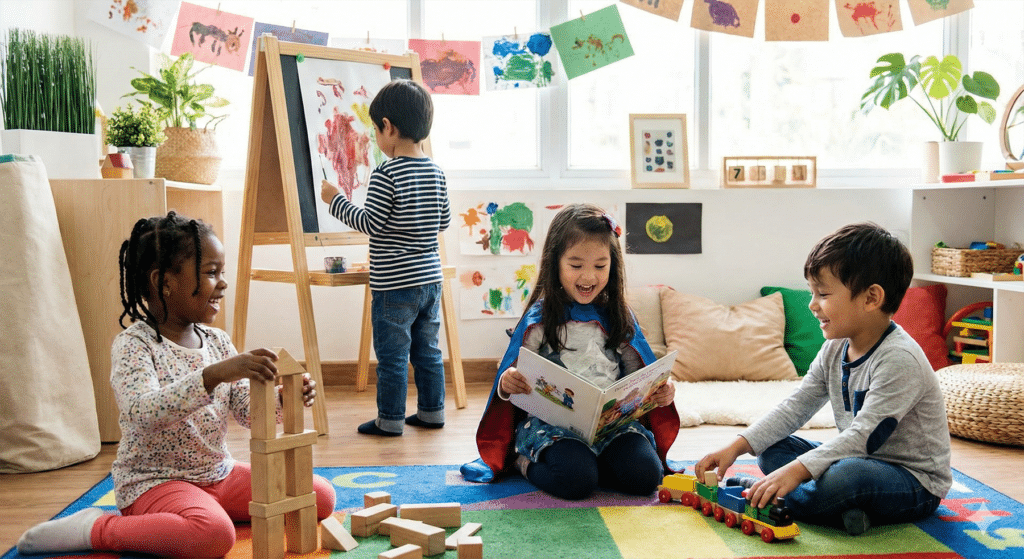
Take mathematics, for example. In a traditional setting, a first-grade student might complete a worksheet on subtraction. In an intentional play setting, a teacher might set up a “grocery store” where items have prices and students have limited budgets. To “buy” ingredients for a pretend meal, they must perform subtraction.
Recent applications of this method, such as the “Math Machine” game highlighted by Edutopia, have students create physical gestures and sounds to represent numbers, literally “embodying” math concepts. This aligns with findings from the “Science of Math” movement, which emphasizes that conceptual understanding must precede rote memorization. When students build foil boats to test how many pennies they can hold before sinking, they aren’t just splashing water; they are engaging in the iterative scientific process of hypothesis, testing, and revision.
The ROI of Play: Social-Emotional Outcomes
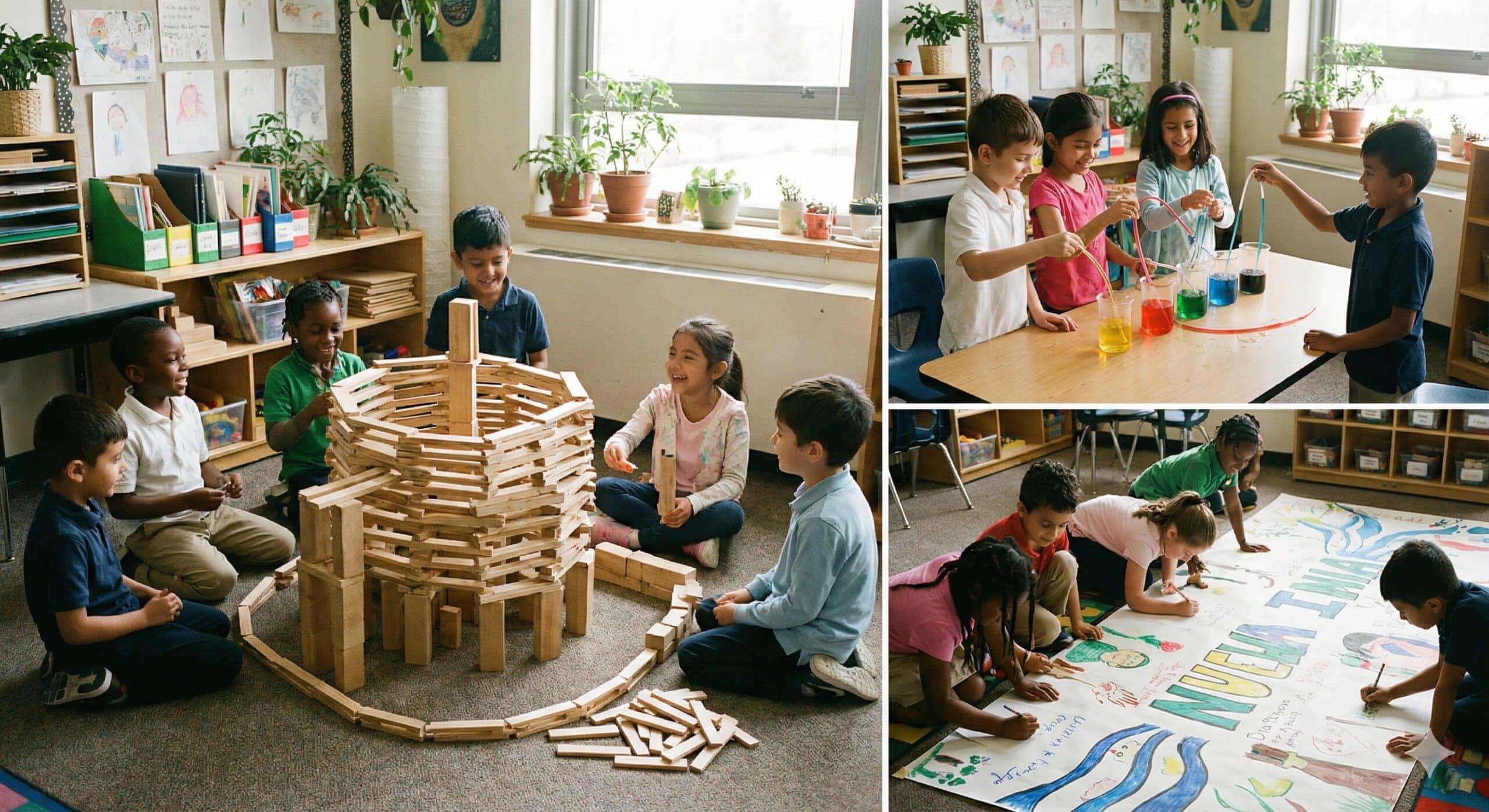
Beyond test scores, intentional play is a powerhouse for Social-Emotional Learning (SEL). When children navigate a shared game or build a block tower together, they are constantly negotiating rules, managing frustration, and practicing empathy.
The data backs this up. Research aggregated by the Collaborative for Academic, Social, and Emotional Learning (CASEL) indicates that students participating in evidence-based SEL programs showed an 11-percentile-point gain in academic achievement. Furthermore, the economic argument is strong: CASEL reports a return on investment of roughly $11 for every $1 spent on SEL interventions.
In a play-based classroom, these skills are practiced in real-time. If a student’s “store” runs out of “money,” they have to problem-solve. If their foil boat sinks, they must practice resilience to build a better one. These are life skills that worksheets simply cannot simulate.
Moving Forward
The resurgence of play in primary education is not a step backward; it is a realignment with how the human brain actually learns. As evidenced by the 2024 implementation of play-based mandates in states like Connecticut, policymakers are beginning to recognize what researchers have known for years: rigor and joy are not mutually exclusive.
By embracing intentional play, we stop forcing children to choose between having fun and getting smart. Instead, we provide a learning environment where they can do both—naturally, deeply, and effectively.
References
- Collaborative for Academic, Social, and Emotional Learning (CASEL). (n.d.). What Does the Research Say? Retrieved from https://casel.org
- Edutopia. (2025). Using Theater Games to Support Students’ Math Skills. George Lucas Educational Foundation.
- Heubeck, E. (2025). Play-Based Learning Yields More Joy, Higher Scores at This Elementary School. Education Week.
- Weisberg, D. S., Hirsh-Pasek, K., Golinkoff, R. M., Kittredge, A. K., & Klahr, D. (2016). Guided Play: Principles and Practices. Current Directions in Psychological Science, 25(3), 177–182.
- Zosh, J. M., et al. (2022). The Scientific Case for Learning Through Play. The LEGO Foundation.