
Karen, I hear what you are saying, and I agree, but when? When are we supposed to work this in? Leadership tells me, “I know that play is important, but find me instructional minutes.” Our education system needs to stop thinking about ‘working this in’ and making it the instructional approach to learning. I know that educators are competing with curriculum, assessments, IEP, 504 and dysregulated children.
As an advocate for play, I can tell you that when children are engaged and feeling joy in the classroom, dysregulated behaviors will immediately go away. Children do not want to elope from a room that is ‘fun.’ We never want the hallway to be more exciting than the classroom. When we think of play-based experiences as a means to support standards and academic goals, that is how we ‘fit’ it in.
Standards are a part of individualized education plans, all grade level expectations, and common across all classrooms in the state within the same grade. When we put standards at the forefront of planning, and use curriculum as the basis for the topics, we find time in our day for play-based experiences. Curriculum is the resource that supports the standards. So, how do we change systems that are impactful for children and break down the silos?
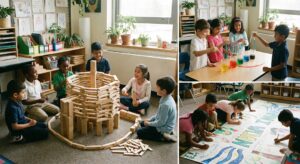
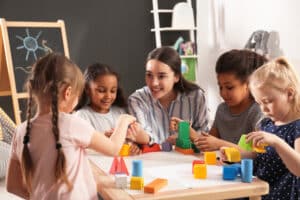
You must think about staffing differently. Play-based experiences support all types of learning, which means we need to think about support staff pushing into play rather than pulling out of the classroom. Are there times that explicit, 1:1 instruction needs to happen for some children? Absolutely! However, how often do we teach explicit skills in a small office down the hallway, without any opportunity to practice the skill in a real-world opportunity? Let’s talk about sharing, but never go to the playground and practice sharing. Let’s practice isolated speech sounds, but never use them with our peers. Practicing in authentic spaces, with peers in how the true learning is solidified. So, have support staff push in because it is much more beneficial for children to learn speech sounds in an authentic space where they are practicing communication and sharing.
Wouldn’t it be more authentic for children to be practicing gross motor, fine motor. reading, math skills in an authentic play-based environment alongside peers. Have support staff working alongside the children, supporting, complimenting and noticing successes in the play environment, where all children feel comfortable taking risks. When we think about using support staff differently and prioritizing the standards, we will find time in our day for play.